How to Become a School Counselor
To become a school counselor, you’ll need a bachelor’s degree, a master’s in school counseling, supervised fieldwork (700+ hours), and a passing score on your state’s certification exam. Most states also require a separate certification or licensure application. The full path typically takes six to eight years. Requirements vary by state.


School counseling sits at the intersection of education and mental health support. You might spend Monday morning helping a sophomore map out her college application timeline, Tuesday afternoon running a small group session on stress management for sixth graders, and Wednesday morning responding to a crisis when a student discloses something serious. The role varies by grade level, but the core stays the same: you’re the person students can come to when they need help figuring out what’s next.
What Does a School Counselor Do?

School counselors work with students from kindergarten through 12th grade, though the day-to-day looks different depending on where you work.
Elementary school counselors focus on early social and emotional development — building classroom lessons around friendship skills, self-regulation, and recognizing feelings. They often catch early warning signs before problems become bigger ones.
Middle school counselors navigate the trickiest terrain. Students this age are going through rapid changes socially and emotionally, and counselors spend a lot of time helping kids manage peer conflict, academic transitions, and identity questions.
High school counselors lean heavily into college and career planning alongside social-emotional support. A student figuring out whether college is even the right path, a senior dealing with anxiety over applications, a junior who needs to know what financial aid actually looks like — these are the daily conversations.
All three settings use the ASCA National Model as a framework, which organizes a counselor’s work into four areas: school counseling curriculum, individual student planning, responsive services, and systems support.
Steps to Become a School Counselor

The path to becoming a school counselor runs through a master’s degree and state certification. Here’s how it breaks down.
Step 1: Earn a Bachelor’s Degree
You don’t need a specific undergraduate major to get into a school counseling master’s program, but degrees in psychology, education, sociology, or social work give you a strong foundation. Focus on coursework that builds your understanding of human development, research methods, and communication. Most master’s programs expect a 3.0 GPA or higher for admission.
Step 2: Complete a Master’s Degree in School Counseling
This is the central credential. A master’s in school counseling typically takes two to three years and covers counseling theory, developmental psychology, group counseling, career development, and school-specific curriculum design. Look for programs accredited by CACREP — the Council for Accreditation of Counseling and Related Educational Programs. CACREP accreditation matters for two reasons: several states require it for licensure eligibility, and it sets a consistent standard for your fieldwork hours. You can find CACREP-accredited master’s programs organized by state on our program guide.
Step 3: Complete Supervised Fieldwork
CACREP-accredited programs require a minimum of 100 hours of practicum (with at least 40 hours in direct student contact) and 600 hours of internship (with at least 240 hours direct). That’s 700 fieldwork hours total before you’re eligible to graduate. Your program will place you in a school setting under a licensed supervisor. Most students complete their internship during their second or third year of the master’s program. For a closer look at what that experience involves, see our overview of how internships prepare school counselors.
Step 4: Pass Required Certification Exams
Most states require at least one exam before you can receive your school counselor credential. The most common is the Praxis School Counselor Assessment (test code 5422). Some states use additional or alternative exams — confirm your state’s current requirement before you register, since exam requirements do change.
Step 5: Apply for State Certification or Licensure
Here’s a distinction that trips people up: certification and licensure aren’t always the same thing. Most states issue a school counselor certification through the state department of education — this is what authorizes you to work in public K-12 schools. Some states also issue or require a separate counseling licensure through a professional licensing board, which may involve additional supervised hours beyond your graduate program. Some states are actively transitioning from traditional certification to a licensure model. Check your state’s current requirements directly through our school counselor certification guide, since these details change.
Step 6: Maintain Your Certification
School counselor credentials aren’t permanent. Most states require ongoing professional development — typically 60 to 90 hours every five years — to renew. Some states require specific training in areas like suicide prevention, trauma-informed care, or implicit bias. Check your renewal cycle when you apply for your initial credential so you’re not caught off guard.
How Long Does It Take to Become a School Counselor?

Plan on six to eight years total. Four years for your bachelor’s degree, two to three years for your master’s program, plus time for exam preparation and the certification application process. If you need to take prerequisite courses before starting your master’s, add another semester. Some career changers with directly relevant work experience find that their graduate programs accept transfer credit that shortens the timeline slightly, but that’s program-specific.
School Counselor Salary and Job Outlook
The median annual salary for school counselors is $65,140 nationally (BLS, May 2024). In elementary and secondary schools specifically, the median is higher at $76,960. Salary varies significantly by state and district — California’s median is among the highest in the country, while rural districts in lower-wage states may pay considerably less. Geography matters more here than in many fields.
The job outlook is solid. The Bureau of Labor Statistics projects 4% growth for school counselors through 2034, with approximately 29,100 annual job openings. Much of that demand comes from increased awareness of student mental health needs and ongoing legislative pressure to reduce counselor-to-student ratios, which currently run well above ASCA’s recommended 1:250 in most districts.
What You’ll Learn in a School Counseling Program
Counseling Techniques
Master’s programs spend significant time on individual and group counseling methods. You’ll learn evidence-based approaches — cognitive-behavioral techniques, solution-focused counseling, motivational interviewing — and practice applying them in supervision. Group work gets particular attention because school counselors run small-group sessions regularly, whether that’s a college-prep group for juniors or a grief support group for students who’ve lost a classmate.
Developmental Psychology
Understanding how children and adolescents develop is foundational to the work. A counselor who knows what’s developmentally typical at age 13 can distinguish normal social friction from something that warrants closer attention. Your coursework will cover cognitive, emotional, and social development across the K-12 span. Our overview of human growth and development for school counselors covers the key frameworks in more depth.
Crisis Management
Crisis response is part of the job, and programs prepare you for it directly. That includes protocols for suicide risk assessment, threat assessment, and trauma response, as well as how to coordinate with administrators, parents, and outside mental health providers. You won’t handle crises alone — schools have response teams — but you’ll often be the first person a student comes to.
Legal and Ethical Issues
Confidentiality, mandatory reporting, informed consent, and dual relationships are covered in depth. When do you hold what a student shares in confidence? When are you legally required to report? How do you handle a situation where a parent’s interests and a student’s interests aren’t aligned? These aren’t edge cases — they come up regularly, and your program prepares you to navigate them within established ethical frameworks.
Cultural Competency
Aisha is a seventh grader whose family immigrated from Somalia two years ago. She’s been avoiding the cafeteria, her grades are slipping, and she hasn’t told anyone why. Her counselor, Ms. Ramirez, starts by asking open questions without assumptions, then learns that Aisha feels isolated — her classmates don’t understand her cultural background, and she’s been avoiding gym class during Ramadan because she’s been too embarrassed to explain why she can’t participate.
Ms. Ramirez works with her teachers to put accommodations in place and connects Aisha with a peer mentoring group for other immigrant students. Within a month, Aisha is back in the cafeteria.
Cultural competency training teaches you to do what Ms. Ramirez did: listen before interpreting, advocate for accommodations, and recognize that a student’s behavior often has context you don’t have yet.
Challenges and Rewards of School Counseling
Caseloads are the most consistent frustration counselors describe. ASCA recommends a 1:250 ratio. The national average is closer to 1:372. That gap means most counselors are stretching to give students the individualized attention the job calls for.
The emotional weight is real too. You’ll work with students who are dealing with family trauma, housing instability, and mental health crises that are beyond what any one counselor can fix. Most counselors describe it as the hardest and most fulfilling work they’ve ever done, often in the same breath.
What keeps people in the profession is the specificity of the impact. Not abstract helpfulness, but watching a kid you’ve worked with for two years walk across a graduation stage with a scholarship offer in hand. That part doesn’t get old.
Switching Careers to School Counseling
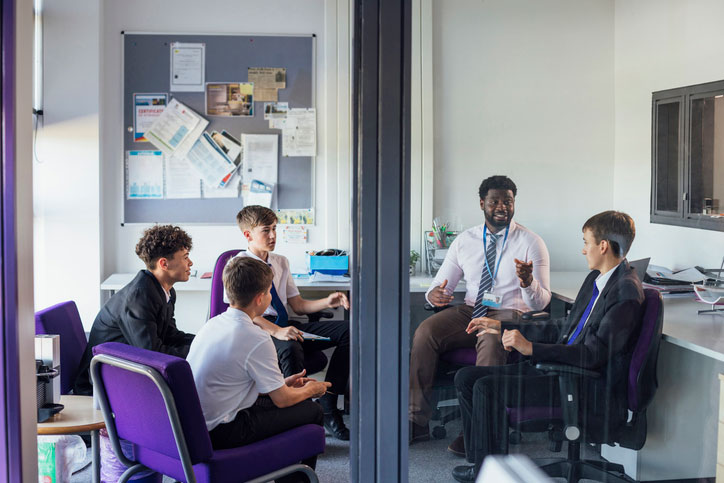
Teachers are among the most natural career changers into school counseling — you already know the school environment, the student population, and the administrative structures. Some states previously required teaching experience for school counselor certification, though many have moved away from that requirement. Check your state’s current rules before assuming your teaching background either helps or is required.
Social workers, healthcare professionals, and human resources staff also bring transferable skills — rapport-building, case management, and knowledge of community resources. The transition typically requires a full master’s in school counseling regardless of your background, since the credential is specific to the school setting.
Frequently Asked Questions
Do you need a master’s degree to become a school counselor?
Yes, in every state. A master’s degree in school counseling or a closely related field is the standard minimum requirement across the country. Some states specify the degree must come from a CACREP-accredited program, so check your state’s requirements before you enroll.
How long does it take to become a school counselor?
Six to eight years is the typical range — four years of undergraduate education plus two to three years for a master’s program, with additional time for exam preparation and the credentialing application process. The timeline varies by state and by how quickly you move through your graduate program.
Do school counselors have to be licensed?
It depends on the state. Most states issue a school counselor certification through the state department of education. Some also require or offer a separate counseling license issued by a professional licensing board. Check your state’s education board directly for current requirements — the school counselor certification guide has state-by-state detail.
What exam do school counselors need to pass?
The most common exam is the Praxis School Counselor Assessment (5422). Some states use different or additional exams. Your state’s department of education will specify which exam or exams are required for initial certification — confirm this before you register, since requirements sometimes change.
Can you become a school counselor without a teaching degree?
Yes, in most states. The requirement for prior teaching experience has been phased out in the majority of states. A few still prefer or require classroom experience, but most states today require only the master’s degree, fieldwork hours, and certification exam. The guidance counselor vs. school counselor overview also addresses how role definitions vary by state.

- Six to eight years total — four years for your bachelor’s, two to three for your master’s, plus exam prep and application time.
- CACREP accreditation matters — several states require a CACREP-accredited program for licensure eligibility, and it sets the standard for your 700 fieldwork hours.
- Certification and licensure aren’t the same thing — most states issue a school counselor certification through the department of education, but some require a separate counseling license. Confirm which your state requires.
- Salary median is $65,140 nationally (BLS 2024), with elementary and secondary schools specifically at $76,960 — geography moves that number significantly.
- Demand is steady — 4% projected growth through 2034 with about 29,100 annual openings, driven largely by growing recognition of student mental health needs.
If you’re comparing master’s programs, start with the state where you plan to practice. Licensing requirements vary, and your program should align with your state’s credentialing process before you enroll.