
School counselors and school psychologists both work in K–12 schools, but they do different jobs and require different degrees. School counselors complete a master’s degree and work with the full student population. School psychologists complete a specialist or doctoral degree and focus on assessment, IEP evaluations, and intensive intervention for students with specific needs.
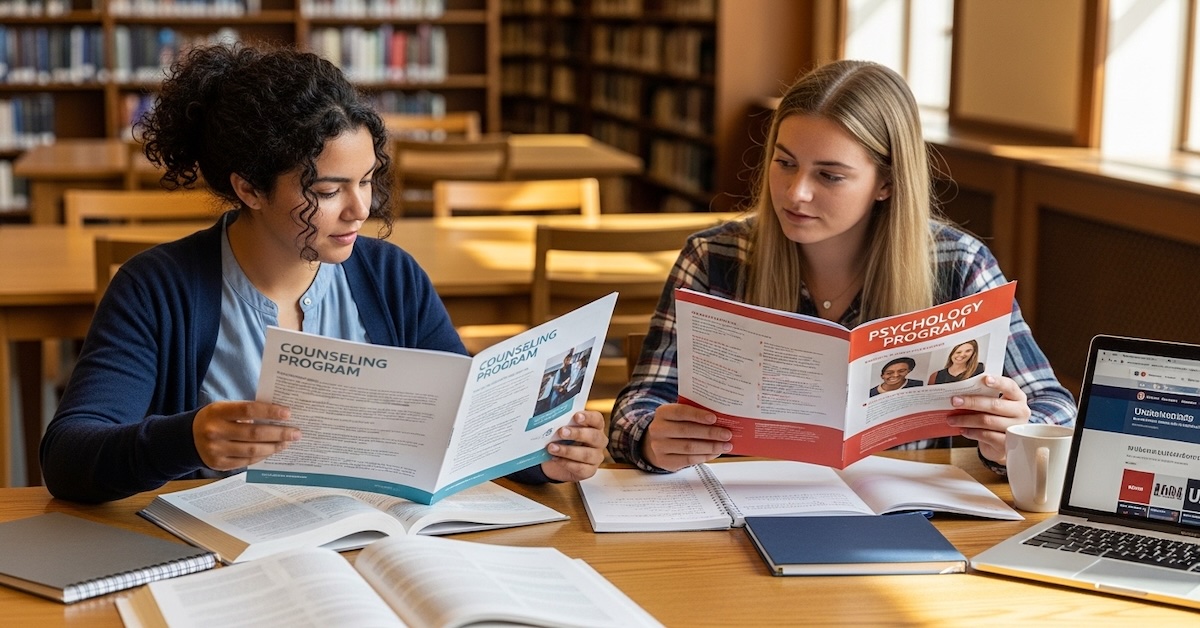
Jordan is a senior finishing a psychology degree. She wants to spend her career working with kids in schools. She’s looked at two program brochures, one for a master’s in school counseling and one for a specialist degree in school psychology, and they both use nearly identical language about “supporting student well-being.” She’s also seen job postings that say “guidance counselor” and isn’t sure if that’s a third option she’s been ignoring. It isn’t. But picking between the first two is a real decision, and it matters.
Here’s what these roles actually look like, how the training differs, and how to figure out which path fits the kind of work you actually want to do.


What “Guidance Counselor” Actually Means (And Why the Term Changed)
If you’ve been searching “guidance counselor vs school counselor” hoping to find two distinct degree programs, here’s the short answer: there’s only one. “Guidance counselor” is the older term for the same role. Most states, school districts, and graduate programs now use “school counselor,” and the American School Counselor Association (ASCA) has been actively moving the profession away from the guidance label for decades.
The terminology shift reflects a real change in what the job involves. The old guidance model was largely reactive. A counselor might pull certain students for schedule changes, college application help, or a conversation after a discipline incident. The work was narrow, often focused on college-track students, and typically siloed from everything else happening in the school.
Modern school counseling looks different. The ASCA National Model, which most graduate programs now build their curriculum around, frames school counseling as a comprehensive program that serves every student, not just the ones who end up in the office. Counselors are involved in classroom lessons, small-group interventions, crisis response, staff consultation, and school-wide data review. The title changed because the job changed.
So if a posting says “guidance counselor,” it almost certainly means school counselor. The license, the degree, and the day-to-day work are the same.
School Counselor vs. School Psychologist: The Core Differences
The real comparison is between two distinct graduate paths: a master’s in school counseling and a specialist or doctoral degree in school psychology. Both roles exist inside K–12 schools. Both support student well-being. But the work looks meaningfully different once you’re in the building.
| Aspect | School Counselor | School Psychologist |
|---|---|---|
| Primary focus | Comprehensive programs for all students: academic planning, SEL, college/career readiness | Assessment and intervention for students with learning, behavioral, or mental health needs |
| Typical role | Large caseload, classroom lessons, small groups, brief counseling, crisis support, family consultation | Psychoeducational evaluations, IEP assessments, behavior intervention plans, staff consultation |
| Degree required | Master’s in school counseling (typically 48–60 credit hours) | Specialist degree (EdS) or doctorate in school psychology |
| Time in grad school | 2–3 years for master’s + supervised fieldwork | 3+ years for EdS; 5–7 years for doctoral track |
| Fieldwork hours | 600–700 hours (practicum + internship; varies by state) | 1,200+ internship hours in most EdS and doctoral programs |
| Typical setting | PK–12 schools; some district-level or college advising roles | PK–12 schools and districts; private practice possible with doctorate |
| Median salary (BLS, May 2024) | $65,140/year; $76,960 in public K–12 settings | $84,940/year (median); $91,990 mean annual wage |
| Credential | State school counselor certification; Praxis School Counselor exam required in many states | State school psychologist credential; doctoral licensure opens additional clinical options |
The overlap on paper can be misleading. In practice, a school counselor might spend a Tuesday morning running a classroom lesson on stress management for 25 eighth-graders, then meeting with a junior who just learned her family is moving, then co-facilitating a small group for students with social anxiety. A school psychologist on the same Tuesday might spend most of the day administering cognitive and achievement assessments for a student being evaluated for a learning disability. That testing feeds directly into an IEP meeting later in the week.
What the Day-to-Day Actually Looks Like
The School Counseling Day
Marcus is a ninth-grader who’s been skipping his third-period class. His teacher flagged it. The school counselor pulls his attendance record, notices the pattern started after winter break, and schedules a check-in. In that meeting, Marcus mentions offhand that things have been tense at home. The counselor doesn’t diagnose anything, because that’s not the role, but she starts building a picture. She connects with his advisor, adjusts his schedule to reduce an academic pressure point, loops in the school social worker, and follows up with Marcus every two weeks. That’s a routine Tuesday.
School counselors carry large caseloads. ASCA recommends a ratio of one counselor per 250 students, but actual national averages are commonly around 1:380–1:420 depending on the year. That reality shapes everything: you’re good at brief, strategic interventions, and you learn how to triage fast.
The School Psychology Day
Dr. Rivera’s week is driven largely by referrals. A third-grader has been struggling with reading and behavior since kindergarten, and the team has finally initiated a special education evaluation. Dr. Rivera administers a full psychoeducational battery — cognitive testing, achievement assessments, behavior rating scales — and writes a report that the IEP team will use to determine eligibility and plan services. She also consults with two teachers about a student’s behavior intervention plan and attends a problem-solving meeting for a student on a 504 plan.
School psychologists do have some direct student contact, and in some districts they run brief counseling groups. But the core of the job is assessment, data interpretation, and consultation, not the broad student-facing work that defines school counseling.
Training, Time, and Cost
A master’s in school counseling typically runs two to three years full-time, covering counseling theory, career development, group work, consultation, and supervised fieldwork. CACREP-accredited programs are generally the strongest option — many states prefer or require CACREP accreditation for licensure, though requirements vary by state. Always verify with your state’s credentialing board before enrolling. Most programs require between 600 and 700 hours of supervised fieldwork split between a practicum and an internship.
School psychology takes longer. The specialist degree (EdS) is the standard entry-level credential and typically takes three or more years after a bachelor’s. Doctoral programs — which open the door to clinical licensure and private practice — run five to seven years. Fieldwork requirements are steeper, often 1,200 hours or more. Programs accredited by the National Association of School Psychologists (NASP) follow a defined set of practice standards.
The time difference translates directly to cost — not just tuition, but the earnings you’re not making while you’re in school. That’s worth factoring in realistically, not as a reason to avoid school psychology if it’s the right fit, but as part of an honest comparison.
Which Degree Keeps More Doors Open?
School counseling is mostly a school-based career. There are exceptions — district-level roles, college advising, some community agency work — but the credential is built for K–12, and that’s where most counselors spend their careers. That’s not a limitation if K–12 is where you want to be. It’s just accurate.
School psychology offers a bit more range. The EdS credential keeps you school-based in most states, but a doctoral degree — combined with additional supervised hours — can qualify you for licensure as a psychologist, which opens agency work, private practice, and assessment consulting. The trade-off is the extra time and cost to get there.
Neither path is the “smarter” career bet. Job demand is solid in both fields. The question is fit.
Questions to Ask Before You Choose
These aren’t trick questions. They’re the ones that tend to clarify things quickly.
Do you want to work with all students or with students who need intensive, specialized support? School counseling is broad by design. School psychology is intensive by design. Both are valuable. They just attract different instincts.
Are you drawn to relationship-building across a whole school community, or to deep-dive assessment and problem-solving? Counselors build relationships at scale. School psychologists go deep on individual cases.
How long are you willing to be in school? If two to three years feels right, school counseling is the cleaner path. If you’re drawn to school psychology but aren’t sure about a doctorate, the EdS gets you into the field faster than a PhD track.
Do you want to stay school-based long-term, or do you want the option of private practice? If you’re thinking about private practice eventually, school psychology with a doctoral path gives you more flexibility. A school counseling credential alone won’t get you there.
If you’re leaning toward school counseling, the next practical step is looking at how to become a school counselor in the state where you plan to practice. Licensing requirements vary enough that your program choice should follow your state, not the other way around.
Frequently Asked Questions
Is a guidance counselor the same as a school counselor?
Yes. “Guidance counselor” is an older term that most schools, states, and professional organizations have moved away from. ASCA recommends “school counselor” to reflect how the role has evolved, moving from reactive scheduling help to comprehensive, data-driven programs serving all students. There’s no separate license or degree for “guidance counseling.”
Can a school counselor do the same things as a school psychologist?
Not exactly. School counselors and school psychologists both support student well-being, but their scope is different. School counselors provide brief counseling, academic and career planning, and school-wide programming. School psychologists conduct psychoeducational assessments, write evaluations for IEPs, and consult on behavior intervention plans. The two roles often collaborate closely, but they’re credentialed separately and licensed to do different things.
Do school psychologists earn more than school counselors?
Generally, yes. According to BLS May 2024 data, school psychologists earned a median annual salary of $84,940, while school counselors and advisors earned a median of $65,140. School counselors working in public K–12 settings specifically earned a median of $76,960. Geography, district size, and years of experience all affect what you’ll actually earn in either role.
Which degree is better for working with elementary school students?
Both school counselors and school psychologists work at the elementary level, so this comes down to what kind of work you want to do. If you want to run classroom lessons, help kids navigate friendships and transitions, and work with the full student population, school counseling fits that well. If you’re drawn to early identification of learning differences, reading disabilities, and developmental assessments, school psychology is the stronger match.
Can I switch from school counseling to school psychology later?
Switching is possible but not simple. A school counseling master’s doesn’t count as credit toward a school psychology EdS or doctorate in most programs, so you’d likely need to complete most or all of the school psychology program from scratch. Some coursework might transfer. A few people do make this move, but it typically means going back to school for two or more additional years. Explore master’s in school counseling programs before committing to either path to make sure the fit is right from the start.
- “Guidance counselor” is not a separate role — It’s an outdated term for school counselor. No separate degree or license exists.
- The real decision is school counseling vs. school psychology — Two distinct graduate tracks with different daily work, different caseloads, and different credential requirements.
- School counseling is broader and faster to complete — A master’s takes two to three years. You’ll work with the whole student population through academic planning, SEL, and crisis support.
- School psychology takes longer but opens more specialized doors — An EdS is three or more years; a doctorate can lead to clinical licensure and private practice eligibility.
- Fit matters more than strategy — Job demand is solid in both fields. The better question is what you actually want to do every day.
If you’re leaning toward school counseling, start by comparing accredited master’s programs. The state where you plan to practice should shape which program you choose.
Explore Master’s Programs